Feedback vs. Behavior: What Customers Really Want (And How to Give It to Them)
 Thu Nghiem
Customer feedback reveals what people say they want, but their behavior shows what they actually do. Learn why these signals often clash, how to interpret behavioral data, and strategies to align feedback with real-world actions for better retention and conversion.
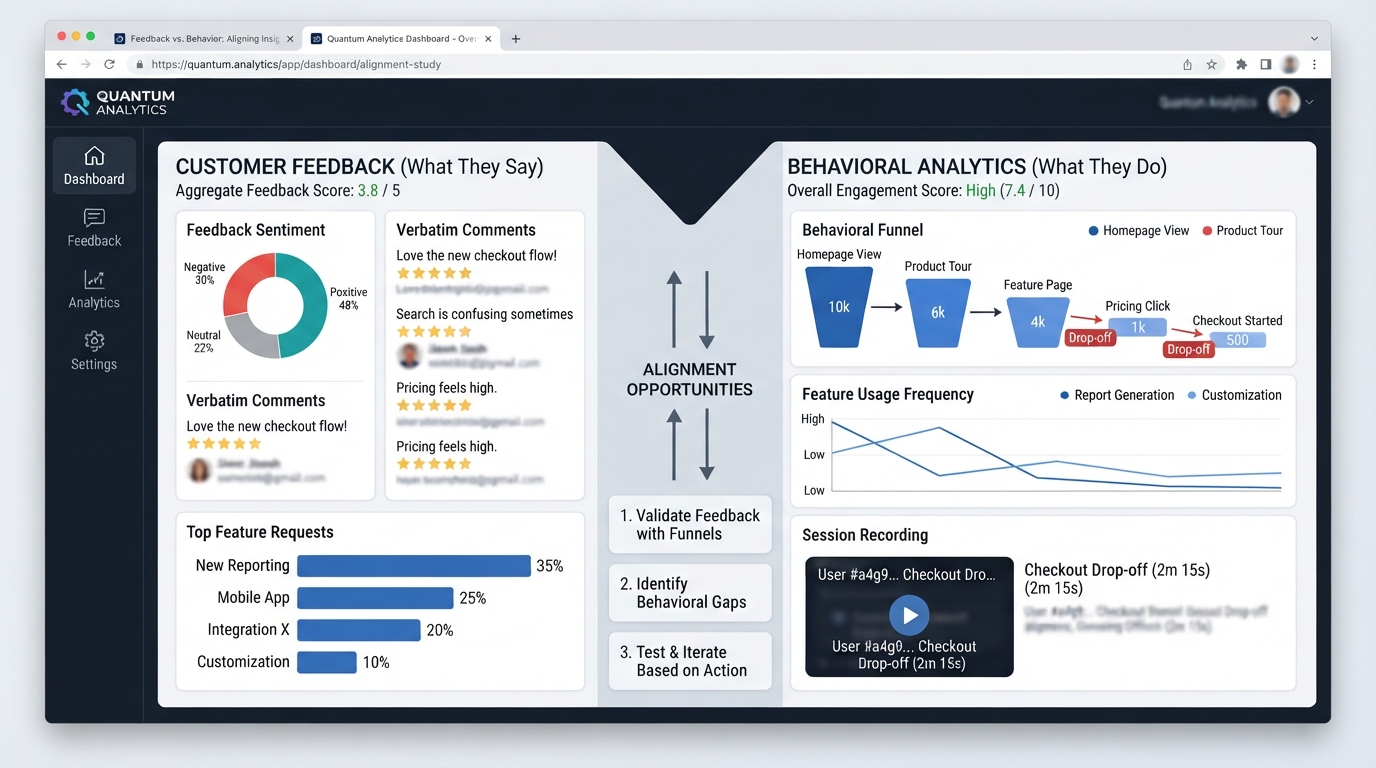
Customer feedback tells you what people say they want. Their behavior shows you what they actually do. When the two don’t match—and they often don’t—brands are left guessing which signals to trust.
Product managers, UX designers, and marketers rely on data to shape experiences, but reconciling stated preferences with real-world actions can feel like solving a puzzle with missing pieces. Feedback alone is incomplete. Behavior alone lacks context. The solution? Use feedback to explain behavior and behavior to validate feedback.
This article explores why the two often clash, what behavior reveals that feedback can’t, and how to combine them for deeper insights. You’ll leave with a framework to align what customers say with what they do—and turn that alignment into better retention, conversion, and experience.
Why Feedback and Behavior Often Clash
Customers say they want privacy, but they’ll hand over personal data for a 10% discount. They claim to love a feature, but they never use it. They rate a product five stars, then abandon their cart. These contradictions aren’t anomalies—they’re the norm.
The Problem: Words vs. Actions
Feedback comes in many forms: surveys, reviews, focus groups, support tickets, and social media comments. Each is a snapshot of how customers perceive their experience. But perception isn’t always reality. Here’s why:
- Social desirability bias: People answer questions in ways they think will make them look good. For example, 80% of users might say they prefer a "minimalist" design, but if given the choice, they’ll click on the flashier option.
- Memory gaps: Customers can’t always recall their own behavior. Ask someone why they abandoned a cart, and they might cite price—but session recordings could show they struggled with a broken checkout button.
- Hypotheticals don’t predict real choices: In focus groups, users might praise a feature they’d never use in practice. A classic example: Netflix found that users said they wanted to rate movies, but their actual viewing behavior revealed they rarely did.
Common Scenarios Where Feedback Misleads
- Surveys: A customer rates their satisfaction as "very high" but stops using the product a week later. The survey captured their mood in the moment, not their long-term engagement.
- Reviews: A product with 4.8 stars might still have a 30% return rate. Reviews often reflect extremes (either love or hate), not the silent majority.
- Focus groups: Participants might say they’d pay more for a premium feature, but in reality, they’ll stick with the free version. Hypothetical willingness to pay rarely matches actual spending.
The takeaway? Feedback is a starting point, not the final answer. It tells you what customers think, but not why they act the way they do.
What Behavior Actually Tells You (That Feedback Can’t)
Behavior is the unfiltered truth. It’s what happens when no one’s watching, when there’s no pressure to perform or please. And unlike feedback, it’s measurable, consistent, and often surprising.
Behavioral Signals to Watch
| Signal | What It Reveals | Example |
|---|---|---|
| Clicks | Interest or confusion | High clicks on a "Help" button may signal poor UX. |
| Time spent | Engagement or frustration | Long time on a page could mean deep interest—or a confusing layout. |
| Repeat usage | Habit formation or loyalty | Users who return weekly are more valuable than one-time visitors. |
| Abandonment | Friction or disinterest | Cart abandonment rates highlight checkout pain points. |
| Scroll depth | Content relevance | If users stop scrolling halfway, the page may be too long or irrelevant. |
How Behavior Reveals Unmet Needs
Feedback might tell you a customer "loves" your product, but their behavior could show they’re one step away from churning. For example:
- A user rates your app 5 stars but hasn’t logged in for 30 days. Their feedback was genuine at the time, but their behavior reveals disengagement.
- A customer says they’d "definitely" refer a friend, but their referral link has never been used. Their words don’t match their actions.
Behavior also uncovers needs customers can’t articulate. Take Netflix’s shift from star ratings to thumbs-up/down. User feedback suggested people wanted granular ratings, but behavioral data showed they rarely used them. Instead, Netflix found that viewing patterns (what people watched, not what they rated) were far more predictive of preferences. This insight led to the recommendation algorithm that now drives 80% of viewing activity.
How to Combine Feedback and Behavior for Deeper Insights
Feedback and behavior aren’t rivals—they’re partners. Feedback explains why behavior happens, and behavior validates whether feedback is trustworthy. Here’s how to combine them:
Step 1: Collect Feedback Contextually
Generic surveys ("How satisfied are you?") yield generic answers. Instead, ask for feedback in the moment, when the experience is fresh. Examples:
- In-app surveys: After a user completes a key action (e.g., "What almost stopped you from checking out?").
- Exit-intent popups: When a user is about to leave, ask, "What’s missing?"
- Post-interaction prompts: After a support chat, ask, "Did this solve your problem?"
Contextual feedback is more accurate because it’s tied to a specific behavior. A user who just abandoned their cart is far more likely to give honest feedback than someone filling out a survey weeks later.
Step 2: Map Feedback to Behavioral Metrics
Look for patterns where feedback and behavior align—or clash. For example:
| Feedback | Behavior | Insight |
|---|---|---|
| "I love this feature!" | Low usage | The feature is nice-to-have, not essential. |
| "The checkout is slow." | High cart abandonment | The feedback is valid—fix the checkout. |
| "I’d pay more for X." | No one upgrades | The feature isn’t worth the price. |
Tools like heatmaps (e.g., Hotjar) and session recordings can help you see how users interact with your product, while sentiment analysis (e.g., MonkeyLearn) can quantify what they’re saying. Together, they paint a fuller picture.
Step 3: Test Hypotheses to Bridge Gaps
When feedback and behavior don’t align, run experiments to uncover the truth. Examples:
- A/B tests: If users say they prefer a minimalist design but click more on a flashy one, test both versions to see which converts better.
- Prototypes: If feedback suggests a feature is missing, build a low-fidelity version and track usage before investing in development.
- Predictive modeling: Use behavioral data to forecast which users are at risk of churn, then follow up with targeted feedback requests (e.g., "We noticed you haven’t logged in lately—what’s holding you back?").
The goal isn’t to prove one source right or wrong, but to understand why the gap exists and how to close it.
When to Prioritize Feedback Over Behavior (And Vice Versa)
Feedback and behavior each have their strengths. The key is knowing when to lean on one over the other.
When Feedback Wins
- Early-stage product discovery: Before you have behavioral data, feedback helps shape direction. Example: A startup might use customer interviews to identify pain points before building a prototype.
- Emotional pain points: Behavior can show what users do, but not how they feel. Example: A user might abandon a form because it’s too long (behavior), but their feedback could reveal they’re frustrated by the lack of progress indicators.
- Exploratory questions: If you’re testing a new idea, feedback helps gauge interest before investing in development. Example: "Would you use a feature that does X?" can save months of wasted effort.
When Behavior Wins
- Habit-forming products: If your product relies on repeated use (e.g., fitness apps, social media), behavior is the ultimate measure of success. Example: A user might say they’ll exercise daily, but their login frequency tells the real story.
- Low-engagement users: Users who don’t provide feedback are still generating behavioral data. Example: A silent user who stops logging in is a churn risk, even if they never complained.
- High-stakes decisions: When the cost of being wrong is high (e.g., pricing changes, major feature launches), behavioral data is more reliable than hypothetical feedback.
Red Flags: Over-Indexing on One Source
- Ignoring churn because NPS is high: A high Net Promoter Score (NPS) is meaningless if users are leaving. Behavior (e.g., retention rates) should always be the tiebreaker.
- Dismissing feedback because "users don’t know what they want": While behavior is often more reliable, feedback can reveal blind spots. Example: Users might not know they want a faster checkout process until they experience it.
- Assuming correlation equals causation: Just because users who spend more time on a page also convert more doesn’t mean the page is the reason. Feedback can help you dig deeper (e.g., "What did you find most helpful on this page?").
How to Close the Loop with Customers
Combining feedback and behavior isn’t just about gathering data—it’s about using it to build trust. Customers want to know their input matters. Here’s how to close the loop:
1. Transparency: Show How Data Shapes Decisions
Customers are more likely to provide feedback if they see it leads to action. Example:
- Changelog updates: "We heard you! Based on your feedback, we’ve simplified the checkout process."
- In-app messages: "You told us this feature was confusing, so we’ve redesigned it. Try it out and let us know what you think."
- Public roadmaps: Share how feedback influenced your product roadmap (e.g., "Top requested feature: Dark mode—coming in Q3!").
2. Personalization: Tailor Feedback Requests to Behavior
Generic surveys get generic responses. Instead, use behavioral data to personalize feedback requests. Examples:
- Abandoned carts: "You left something behind! What almost stopped you from checking out?"
- Inactive users: "We miss you! What’s one thing we could do to make the app more useful?"
- Power users: "You’ve used this feature 10 times this week—what do you love (or hate) about it?"
Personalized requests feel more relevant and are more likely to yield actionable insights.
3. Continuous Iteration: Treat Insights as a Dialogue
Feedback and behavior aren’t one-time data points—they’re part of an ongoing conversation. Example workflow:
- Collect: Gather feedback and behavioral data.
- Analyze: Look for patterns and gaps.
- Act: Test changes based on insights.
- Communicate: Share updates with customers.
- Repeat: Use new data to refine your approach.
This cycle turns passive users into active participants in your product’s evolution.
Key Takeaways
- Feedback and behavior are complementary, not contradictory: Feedback explains why behavior happens; behavior validates whether feedback is trustworthy.
- Behavior reveals what feedback can’t: Clicks, time spent, and abandonment rates show real intent, not just stated preferences.
- Combine both for deeper insights: Map feedback to behavioral metrics, then test hypotheses to bridge gaps.
- Know when to prioritize one over the other: Feedback shines in early-stage discovery and emotional pain points; behavior wins for habit-forming products and low-engagement users.
- Close the loop with customers: Transparency, personalization, and continuous iteration build trust and turn insights into action.
The brands that thrive aren’t the ones with the most data—they’re the ones that know how to listen to it. By aligning feedback and behavior, you’ll stop guessing what customers want and start delivering it.