How product marketers can scale their impact with AI
 Thu Nghiem
Product marketing teams face relentless pressure to create more content, faster—without sacrificing quality or compliance. AI isn’t just a tool; it’s a force multiplier. Discover how agentic SEO can transform your workflow, scale output, and deliver measurable impact while preserving brand voice and governance.
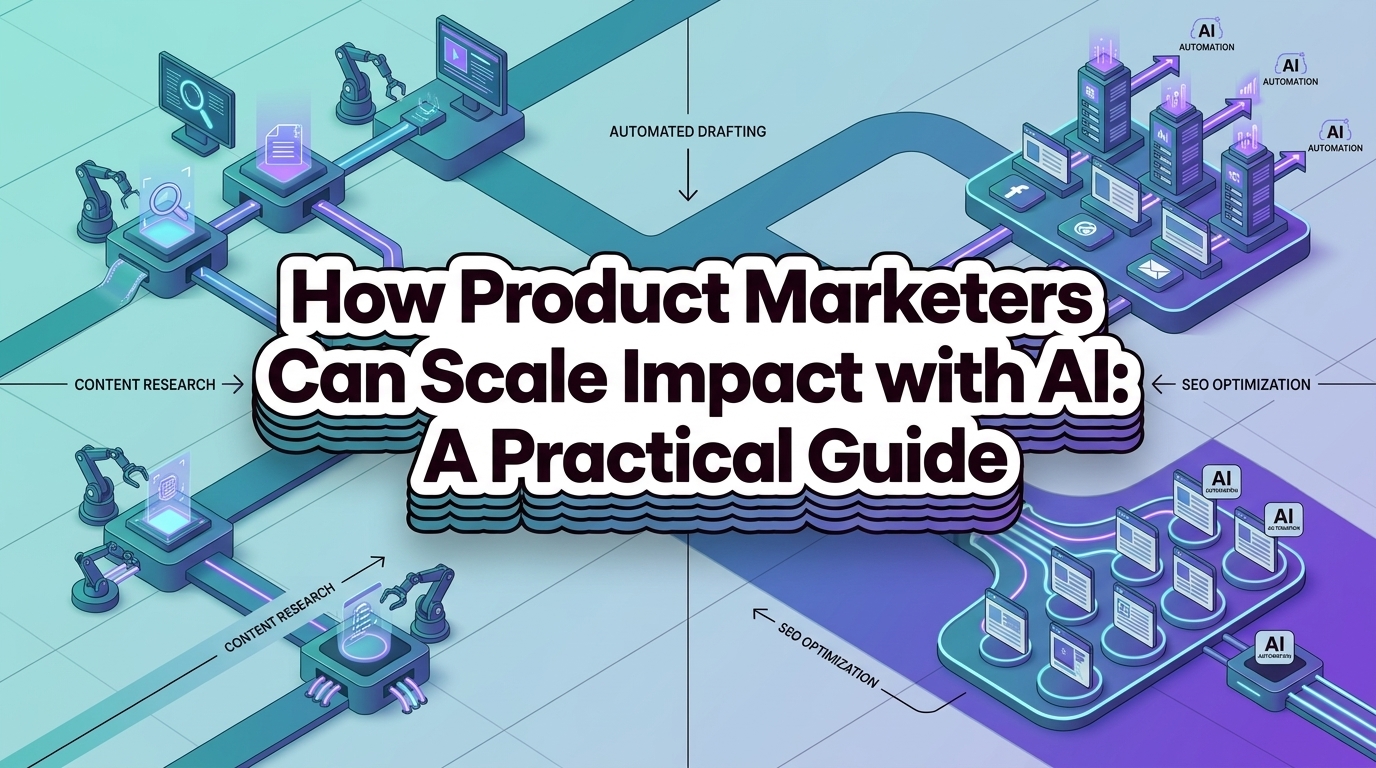
Product marketing teams are under relentless pressure to do more with less. Content demands surge as campaigns multiply, product launches stack up, and global audiences expect personalized messaging. Yet most teams lack the headcount to keep pace without sacrificing quality or compliance.
The solution isn’t to hire faster—it’s to deploy AI as a force multiplier. But not just any AI. Product marketers need systems that scale content creation, personalization, and campaign execution while preserving brand voice, ensuring compliance, and delivering measurable impact.
That’s where agentic SEO comes in. By automating repetitive, high-volume tasks and embedding human oversight at key gates, AI can transform a small team into a high-output engine. This guide shows you how to build that system, step by step.
Why product marketers need AI now
The challenges product marketers face today aren’t new, but they’ve reached a breaking point:
- Rising content demands: Product launches, competitive comparisons, buyer enablement, and post-sale documentation now require dozens of assets per quarter.
- Limited resources: Headcount rarely grows in lockstep with output needs, forcing teams to prioritize quantity over depth.
- Siloed tools: Research, drafting, review, and publishing often live in separate apps, creating friction and context loss.
- Personalization pressure: Global audiences expect region-specific messaging, yet creating tailored versions manually is unsustainable.
AI isn’t a replacement for human insight—it’s a multiplier. When embedded in a structured workflow, AI agents can handle repetitive, high-volume tasks (research, drafting, image generation) while humans focus on strategy, review, and governance.
The result? Teams ship more content, faster, without sacrificing depth or compliance. But only if the AI is deployed intentionally—not as a scattered set of tools, but as a unified pipeline with clear handoffs and human approval gates.
Agentic SEO for product marketers: a scalable workflow
Agentic SEO turns a linear content pipeline into a repeatable system. Each agent owns a stage—research, brief, draft, review, publish—while humans retain control at critical points.
Here’s how it works in practice:
1. Research: From scattered queries to actionable insights
Traditional keyword research relies on manual queries, disjointed spreadsheets, and tribal knowledge. Agentic research pulls data from sources like Search Console, identifies gaps, and clusters keywords by intent and topic depth.
What changes:
- No more juggling five tools or spreadsheets.
- Clusters are built with strategic depth—each page supports the next, creating a content flywheel.
- Data is centralized, so insights aren’t siloed in someone’s notebook.
2. Brief: Structured outlines with intent and targets
A brief isn’t just a document—it’s a blueprint. The brief agent generates structured outlines with:
- Target keywords and semantic clusters
- Competitor gaps and differentiation angles
- Content depth requirements (e.g., “include a buyer’s journey section”)
- SEO targets (word count, readability, internal linking)
Why it matters:
- Eliminates guesswork in drafting.
- Ensures every article aligns with business goals and SEO intent.
- Reduces review cycles because drafts start with clear direction.
3. Draft: First-pass articles in minutes
The drafting agent generates a full article from the brief, including:
- Product positioning and messaging
- Buyer journey sections
- FAQs and objections
- Internal links to related pages
The human role:
- Review for brand voice, accuracy, and compliance.
- Edit, not rewrite—humans refine, agents generate.
4. Review: SEO, brand, and compliance checks
The reviewer agent runs a pre-publication checklist:
- SEO hygiene (meta tags, headings, keyword density)
- Brand voice adherence (tone, terminology, messaging)
- Compliance (EU-hosted workspaces ensure data residency; role-based access limits exposure)
- Conversion readiness (CTAs, form placements)
Outcome:
- Nothing publishes without human sign-off.
- Every asset meets brand and regulatory standards.
5. Publish: One-click to destinations
With a single click, the publisher agent can:
- Send articles to your public blog
- Deploy to BlockForm sites with built-in conversion forms
- Push via webhooks to custom endpoints (Zapier, n8n, Make)
No more tool hopping. Everything flows from one board.
Personalization at scale: AI-driven content and messaging
Product marketers don’t just need more content—they need the right content for the right audience. AI makes personalization achievable at scale.
Modular content blocks
Instead of writing 10 versions of a datasheet, create modular blocks:
- Core messaging (same across regions)
- Region-specific case studies
- Industry-specific use cases
- Language-localized CTAs
AI drafts the base; humans tailor the variants. This approach cuts time-to-market while maintaining relevance.
Automated A/B testing
AI can generate multiple versions of a hero section, headline, or CTA. Pair that with analytics tools to:
- Test messaging variants by segment
- Automate winner selection based on conversion lift
- Scale tests without manual overhead
Global localization
AI agents can translate and localize content while preserving brand voice. Pair with human review to ensure cultural fit and accuracy.
Result: Faster time-to-market for global campaigns, with less manual effort.
Measuring impact: how AI scales outcomes, not just output
AI adoption should be judged by outcomes, not just activity. Track these metrics to quantify impact:
| Metric | Manual Workflow | Agentic SEO Workflow |
|---|---|---|
| Time from brief to first draft | 4–6 hours | 20–30 minutes |
| Time from cluster to publish | 7–10 days | 48 hours |
| Draft quality pass rate | 60–70% | 85–90% |
| Compliance violations | 5–10 per batch | 0–1 per batch |
| Campaign asset turnover | 2–3 per month | 8–12 per month |
These numbers reflect real-world performance in B2B SaaS teams using agentic pipelines. The gains come from:
- Depth over random posts: Clusters are planned strategically, so each asset strengthens the next.
- Human-in-the-loop quality: Review gates catch errors before publication.
- Systemic efficiency: Agents handle repetitive tasks; humans focus on strategy.
Compliance and control: keeping AI safe and on-brand
AI is only valuable if it respects boundaries. For product marketers in regulated or EU-based teams, governance isn’t optional.
EU-hosted workspaces
Ensure all data stays within EU data centers, meeting GDPR and regional compliance requirements. Workspace isolation prevents cross-team data leakage.
Role-based access
Limit who can draft, review, or publish. Audit trails track every change, so you can trace decisions back to their source.
Brand voice enforcement
Agents draft content, but humans approve it. Use style guides and messaging frameworks to train drafting agents. The reviewer agent checks adherence before publication.
Approval gates
Nothing publishes without human sign-off. This isn’t a bottleneck—it’s a safeguard that ensures every asset meets brand and regulatory standards.
Bottom line: AI accelerates output, but governance ensures it stays safe and on-strategy.
Getting started: a 30-day plan for AI adoption
Switching to an agentic workflow doesn’t require a full rewrite. Here’s a 30-day plan to integrate AI incrementally:
Week 1: Assessment and setup
- Audit your current workflow: tools, handoffs, review cycles.
- Identify one high-value content cluster (e.g., product launch pages).
- Set up a workspace with EU hosting and role-based access.
- Configure your research agent to pull Search Console data.
Week 2: Pilot the pipeline
- Run a full agentic pipeline on your cluster: research → brief → draft → review.
- Compare the agentic draft to your manual version. Note time saved and quality gaps.
- Refine your briefing template based on what worked.
Week 3: Optimize and personalize
- Introduce modular content blocks for your campaign assets.
- Set up the reviewer agent with your brand voice and compliance rules.
- Run a localized version of a core asset through the system.
Week 4: Scale and automate
- Publish the pilot cluster to your destinations (blog, BlockForm sites, etc.).
- Connect webhooks to your CRM or analytics platform for tracking.
- Document your workflow so new team members can onboard quickly.
Tools to evaluate:
- Research agents (data ingestion, clustering)
- Drafting agents (article generation, modular blocks)
- Image generators (hero images, OGs)
- Review checklists (SEO, brand, compliance)
- Publisher (one-click to destinations)
The bottom line
AI isn’t a silver bullet, but it is a force multiplier. For product marketers in B2B SaaS, agentic SEO transforms scattered tasks into a repeatable pipeline—where research, drafting, review, and publishing flow seamlessly from one board.
The result? More content, faster delivery, deeper personalization, and stronger compliance—without adding headcount. Small teams ship like enterprise marketing departments.
The question isn’t whether to adopt AI. It’s how soon you can put it to work. Start with one cluster, run it through the full pipeline, and measure the impact. You’ll see the difference in weeks.
Next step: Pick a high-value content cluster and run it through your agentic pipeline. Time the process end-to-end, and compare it to your previous workflow. The gap will tell you everything you need to know.