How to Write Introduction Paragraphs for Topic Clusters: A Practical SEO Guide
 Thu Nghiem
Learn how to craft high-converting introduction paragraphs for topic clusters that boost SEO, improve engagement, and strengthen your B2B content strategy. Includes examples, templates, and best practices.
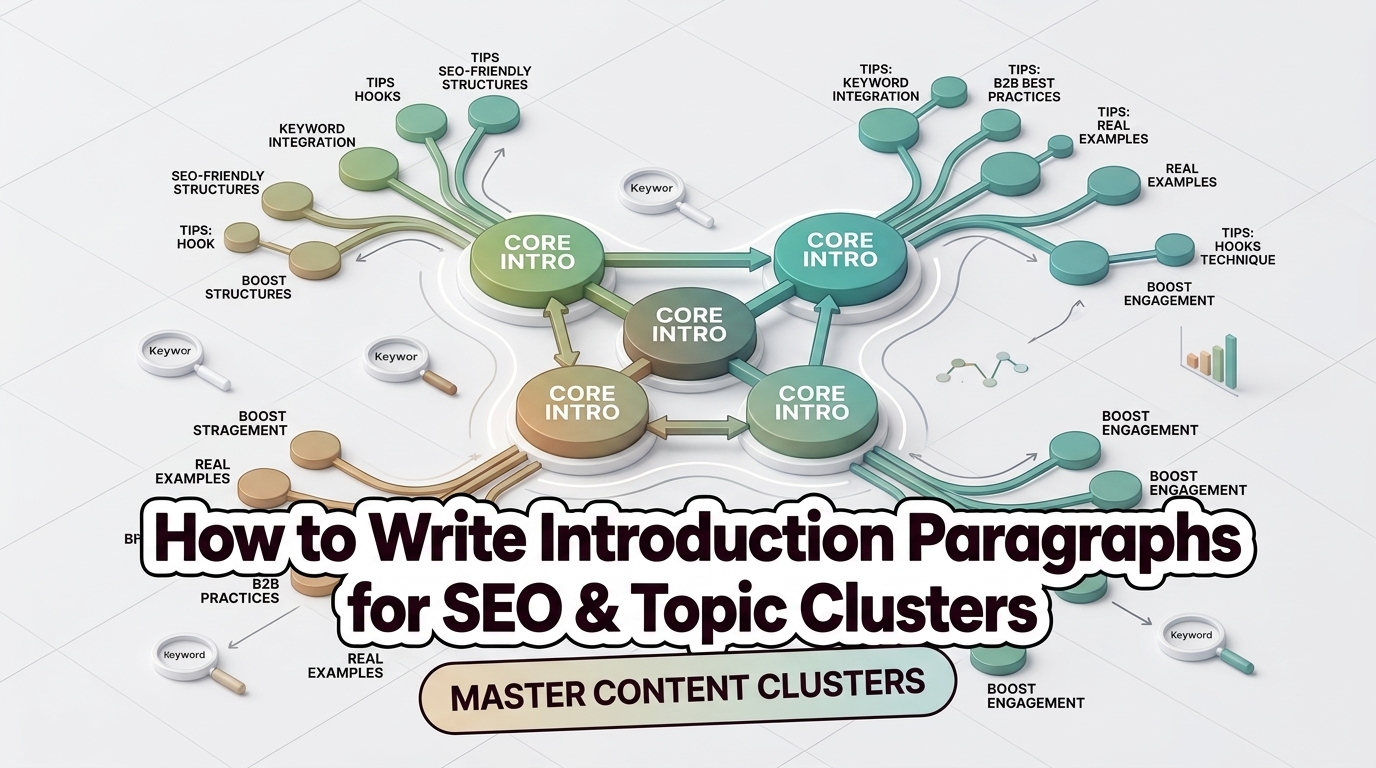
Why Introductions Matter in Topic Clusters
A topic cluster is a content strategy that groups related articles around a central pillar page, with each cluster page covering a subtopic in depth. Introductions are the first impression—and the first opportunity to signal relevance to both readers and search engines. When done right, a strong introduction does three things:
- Anchors the cluster: It sets the stage for the subtopic, making it clear how this page fits into the larger conversation.
- Improves SEO signals: Google uses dwell time and bounce rate to gauge content quality; a well-crafted intro keeps readers engaged and lowers abandonment.
- Enables internal linking: A natural link to the pillar or related cluster pages strengthens the topical authority of your entire site.
For B2B SaaS teams, where content fuels lead generation and product education, the introduction is more than a formality—it’s a conversion lever. A vague or keyword-stuffed intro can lose a reader before they reach your CTA. A clear, intent-driven intro can guide them deeper into the cluster and closer to a conversion.
Core Elements of a Strong Cluster Introduction
Every effective cluster introduction follows a simple but intentional structure. Think of it as a five-part framework that balances readability with SEO:
-
Hook (1–2 sentences) Immediately address the reader’s intent. Ask yourself: What problem are they trying to solve? Use a direct question, a surprising stat, or a relatable pain point.
-
Context (1 sentence) Provide just enough background to frame the topic without over-explaining. This helps readers decide if the page is relevant to their needs.
-
Bridge (1 sentence) Connect the context to the specific cluster topic. This transitions from the general to the specific, setting up the thesis.
-
Thesis (1 sentence) State the core takeaway or purpose of the page. This gives readers confidence that the article will deliver what they’re looking for.
-
Keyword Integration (natural placement) Include the primary keyword and 1–2 secondary terms early in the intro—ideally in the first 50–70 words. Avoid forced repetition; prioritize natural flow.
-
Subtle CTA (optional) End with a low-pressure prompt that guides the reader forward, such as “Let’s dive into the key differences” or “Here’s how to get started.”
This structure isn’t rigid, but it ensures every introduction serves two masters: the reader and the algorithm.
Best Practices for Writing Cluster Introductions
Writing for topic clusters requires a different mindset than writing standalone blog posts. Your introductions must work harder because they’re part of a larger ecosystem. Here’s how to get it right:
Match User Intent with Precision
Search intent falls into three main categories:
- Informational: “What is a topic cluster?”
- Navigational: “How to set up a topic cluster in HubSpot”
- Commercial: “Best topic cluster tools for SEO in 2026”
Your introduction should mirror the user’s intent from the query. For example, if the keyword is “how to write an introduction for SEO,” your intro should immediately answer that question—not launch into a history of content marketing.
Keep It Concise and Scannable
B2B readers skim. Aim for 3–5 sentences total—about 60–90 words. Cut filler phrases like “In today’s fast-paced digital landscape…” or “At our company, we believe…” These add zero value and dilute your message.
Use Internal Links Strategically
Link to 1–2 related cluster or pillar pages naturally within the introduction. For instance, if your cluster is about “SEO tools,” you might link to the pillar page “The Ultimate Guide to SEO Tools” in the first paragraph. This signals to Google that your site covers the topic comprehensively—and keeps readers on your site longer.
Write in a B2B Tone: Direct and Technical
Avoid vague language like “revolutionary solution” or “game-changing platform.” Instead, use clear, actionable statements:
- “Topic clusters help SaaS teams organize content around core topics to improve SEO rankings.”
- “A well-structured cluster can reduce bounce rate by up to 25%.”
This tone aligns with B2B audiences who prioritize clarity and evidence over hype.
Prioritize Keyword Placement Over Density
Use your primary keyword once in the first paragraph, and secondary keywords once or twice more in the next two paragraphs. Overloading keywords makes the text feel unnatural and can trigger spam filters. Tools like SurferSEO or Clearscope can help you check keyword density and placement without guesswork.
Avoid Common Pitfalls
- Keyword stuffing: Repeating “introduction paragraphs” six times in the first 100 words.
- Generic openings: “Welcome to our comprehensive guide on introduction paragraphs…” (tell me why I should care).
- Ignoring internal links: Missing an opportunity to reinforce your cluster structure.
- Over-explaining: Jumping into definitions or background before stating the purpose.
Common Mistakes to Avoid
Even experienced writers fall into traps when writing for topic clusters. Here are the most frequent missteps—and how to fix them:
| Mistake | Why It Hurts | How to Fix It |
|---|---|---|
| Overloading with keywords | Feels unnatural, triggers spam filters, hurts readability | Use keywords once in the first paragraph and once more naturally later |
| Writing generic openings | Doesn’t differentiate your content; loses reader interest | Start with a specific pain point or question |
| Ignoring internal links | Weakens cluster authority and user engagement | Link to 1–2 related cluster or pillar pages in the intro |
| Making it too long | Readers bounce before getting to the value | Aim for 3–5 sentences max |
| Being too salesy | Feels pushy, especially for technical topics | Write like a consultant, not a salesperson |
| Failing to match intent | Content doesn’t align with what the user searched for | Audit search intent before writing |
The goal isn’t to write a perfect paragraph every time—it’s to avoid sabotaging your cluster’s performance from the first sentence.
Examples and Templates for B2B SaaS Clusters
The best way to learn is by example. Below are three real-world introductions from B2B SaaS content clusters, followed by fill-in-the-blank templates you can adapt for your own topics.
Example 1: “How to Write an Introduction for SEO” Cluster
Introduction:Struggling to rank your SaaS content? A weak introduction can kill your SEO efforts before readers even scroll. The first 50 words set the tone for dwell time, bounce rate, and search visibility. But most introductions waste this opportunity with vague fluff or forced keywords. In this guide, we’ll show you how to craft introductions that hook readers, satisfy intent, and strengthen your topic cluster—so your content ranks higher and converts better.
Why it works:
- Hook: “Struggling to rank your SaaS content?” addresses a common pain point.
- Context: Connects the problem (weak intros) to SEO outcomes.
- Bridge: Points to a solution (“in this guide”).
- Thesis: Clear outcome (rank higher, convert better).
- Keywords: “introduction,” “SEO,” and “topic cluster” are integrated naturally.
- CTA: Implied next step (read the guide).
Example 2: “What Are Topic Clusters?” Pillar Page
Introduction:If your SaaS blog reads like a scattered collection of posts, you’re missing a strategic advantage: topic clusters. This SEO framework organizes related content around a central pillar, making it easier for search engines to understand your expertise. But how do you set one up without wasting months? This guide walks you through the step-by-step process of building clusters that rank, retain readers, and drive qualified leads—even on tight deadlines.
Why it works:
- Hook: Positions clusters as a solution to a common problem (scattered content).
- Context: Explains what clusters are and why they matter.
- Bridge: Transitions to the “how-to” angle.
- Thesis: States the core benefit (rank, retain readers, drive leads).
- Keywords: “topic clusters,” “SEO framework,” and “build clusters” are integrated naturally.
- CTA: Guides the reader to the next section.
Example 3: “Best Topic Cluster Tools for SEO” Cluster
Introduction:Choosing the right tools can make or break your topic cluster strategy. Manual keyword mapping and internal linking don’t scale—and spreadsheets won’t help you track performance. That’s why teams use dedicated SEO tools to plan, optimize, and monitor clusters efficiently. In this roundup, we compare the top tools for B2B SaaS teams, including features, integrations, and pricing—so you can pick the best fit for your workflow.
Why it works:
- Hook: Highlights a pain point (manual processes don’t scale).
- Context: Explains why tools are necessary.
- Bridge: Points to a solution (a tool comparison).
- Thesis: States the deliverable (tool comparison with actionable insights).
- Keywords: “topic cluster tools,” “SEO,” and “internal linking” are integrated naturally.
- CTA: Encourages reading the full comparison.
Fill-in-the-Blank Templates
Use these templates as starting points for different types of cluster introductions:
Template 1: “How to…” Cluster
“Struggling to [specific problem]? Most [target audience] waste time on [common mistake], but small tweaks can [desired outcome]. In this guide, we’ll walk you through [process name]—a step-by-step method to [achieve goal]—so you can [benefit] without [pain point].”
Template 2: “What is…” Pillar Page
“[Term] is more than a buzzword—it’s a strategic framework that helps [target audience] [achieve goal]. But how does it work in practice? This guide breaks down [term] into [number] key components, with real-world examples and tips to [benefit].”
Template 3: “Comparing…” Cluster
“From [tool A] to [tool B], choosing the right [category] can feel overwhelming. Each option claims to [key benefit], but [common pitfall] often goes unnoticed. In this comparison, we test [criteria] across [number] leading tools—so you can pick the best fit for your [use case].”
Template 4: “Why…” Cluster
“If you’re still questioning whether [topic] is worth your time, consider this: [statistic or outcome]. Yet many [target audience] skip this step, assuming it’s [common misconception]. Here’s why [topic] matters—and how to [action] for maximum impact.”
Tools and Workflow Tips for Writing Cluster Introductions
Writing effective introductions isn’t a solo task—it’s part of a larger content pipeline. Here’s a workflow that B2B SaaS teams can follow to ensure consistency and quality:
Step 1: Research Intent Before Writing
Use tools like Ahrefs, SEMrush, or Google Search Console to analyze the top-ranking pages for your target keyword. Look for patterns in:
- Opening sentences
- Keyword usage
- Internal linking structure
This research helps you mirror what’s working—and avoid what isn’t.
Step 2: Draft Intros Early in the Process
Write your introduction after the brief and before the outline. This ensures your intro aligns with the cluster’s strategic goals. If you wait until the end, you risk writing a generic placeholder that doesn’t serve the cluster’s purpose.
Step 3: Use SEO Tools to Optimize
Tools like SurferSEO, Clearscope, or MarketMuse can analyze your draft against top competitors. They’ll flag missing keywords, unnatural phrasing, or readability issues—so you can refine before publishing.
Step 4: Review During Final QA
Before hitting publish, check your introduction for:
- Tone alignment with your B2B voice
- Natural keyword placement
- Internal links to pillar or cluster pages
- Length (aim for 3–5 sentences)
- Presence of a clear thesis or takeaway
Step 5: Iterate Based on Performance
After publishing, monitor metrics like bounce rate, dwell time, and scroll depth for cluster pages. If an introduction underperforms, test a new version that better matches user intent or improves clarity.
Conclusion: Build Cluster-First Introductions That Rank and Engage
Introductions aren’t just the first paragraph—they’re the foundation of your topic cluster’s success. A well-crafted intro sets context, signals intent, integrates keywords naturally, and guides readers deeper into your content ecosystem. For B2B SaaS teams, this means more than rankings—it means retaining engaged visitors who are primed to convert.
Start with intent. Keep it concise. Link strategically. And always write for the reader first. When you do, your cluster pages will perform better, rank higher, and deliver more value—without relying on guesswork.